

There comes a point in every project, business, community group or open source team where the biggest obstacle isn't a lack of ideas or a shortage of effort.
It's the leader.
The person at the top is often the one slowing everything down. Not because they aren't capable, but because they're trying to do too much.
Many people think leadership is about making the big decisions, setting the direction and inspiring others. Those things matter, but they're only part of the picture.
Real leadership is about delegation.
The Delegation Funnel
Delegation isn't simply handing someone a task because you're busy. It's about deliberately deciding where your time creates the most value, and making sure everything else is handled by someone else whenever possible.
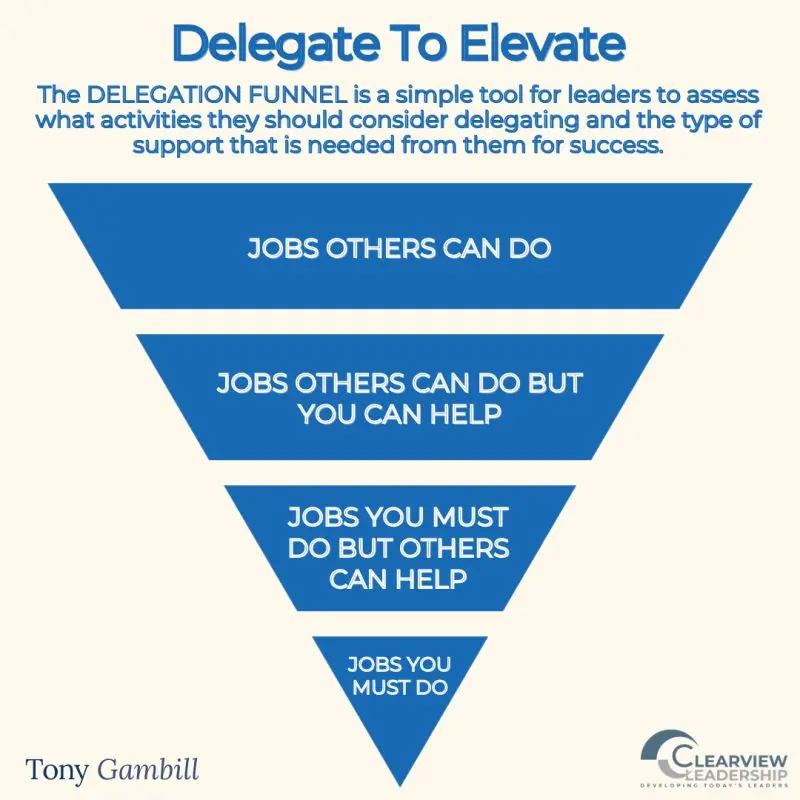
I like to think of delegation as an upside-down pyramid – or a funnel.
At the wide top of the funnel are all the jobs that other people can do.
These are the routine tasks that don't require your specific knowledge or authority. They may be important, but they don't need you. Every minute you spend doing these jobs is a minute you're not spending on the things only you can contribute.
The next level down contains the jobs that others can do, but where they still benefit from your guidance.
Perhaps someone is learning a new skill. Maybe they need feedback or occasional direction. You're still involved, but you're no longer doing the work yourself. Instead, you're helping someone else succeed.
This is where many leaders make the biggest difference. By investing time in teaching and mentoring, they gradually move more work into the first category.
Further down the funnel are the jobs that you must do, but where others can help.
These are tasks that require your expertise, authority or final decision, but not every part of the process depends on you. Someone can gather the information, prepare the paperwork, write the first draft, organise the meeting or carry out the research. You still own the outcome, but you don't have to carry the entire workload alone.
Finally, at the narrow point of the funnel, are the jobs that only you can do.
These are the responsibilities that define your role. Setting the vision. Making the difficult decisions. Taking responsibility when things go wrong. Building relationships that nobody else can build. Protecting the culture of the organisation.
If you spend most of your day here, you're leading.
If you spend most of your day at the top of the funnel, you're probably just busy.
A Leader's Most Important Job
Many people think the leader's job is to make sure all the work gets done.
It isn't.
The biggest task of any leader is to find people who can do the work and then encourage them to do it.
That means spotting potential before someone sees it in themselves. It means giving people opportunities, trusting them with responsibility and supporting them when they inevitably make mistakes. It means helping them grow instead of protecting your own position.
A leader who measures success by the number of tasks they complete has misunderstood the role.
A leader who measures success by the number of people they have helped become capable leaders has understood it perfectly.
The greatest legacy of any leader isn't the work they personally accomplished.
It's the people they inspired, developed and trusted to carry the work forward.
Delegation Builds People
Delegation is not about reducing your workload. It's about increasing the capability of everyone around you.
Every task you successfully delegate helps someone become more experienced, more confident and more valuable to the team. Over time, the organisation becomes stronger because knowledge is spread instead of concentrated in one person.
The Open Source Lesson
This is especially true in open source communities.
We've all seen projects where one person reviews every pull request, answers every support question, writes every blog post and makes every decision. It might work for a while, but eventually that person becomes the bottleneck.
The project doesn't stop because there's no talent. It stops because nobody else has been given the opportunity to grow.
The Cost of Not Delegating
Delegation is an investment.
At first it feels slower. Explaining a task often takes longer than doing it yourself. You answer questions, review the work and occasionally fix mistakes.
That's the short-term cost.
The long-term reward is that next time they won't need as much help. Eventually, they won't need any help at all.
The irony is that the people who insist, "It's quicker if I do it myself," often end up trapped by that decision. Months or years later they're still doing the same jobs because they never invested the time to teach someone else.
I'll be brutally honest here: this has been my biggest failure as a leader. I've struggled with delegation for decades, and it's something I still battle with every day. Like many problems, the first step is acknowledging that it exists.
The Real Measure of Leadership
Good leaders don't measure their success by how indispensable they become.
They measure it by how unnecessary they make themselves.
If your team can't function without you, you've built dependency.
If your team succeeds even when you're away, you've built leadership.
The goal isn't to do everything.
The goal is to make sure everything gets done by the right person.
That's what leadership is really about.


 Congratulations, you discovered a hidden secret!